
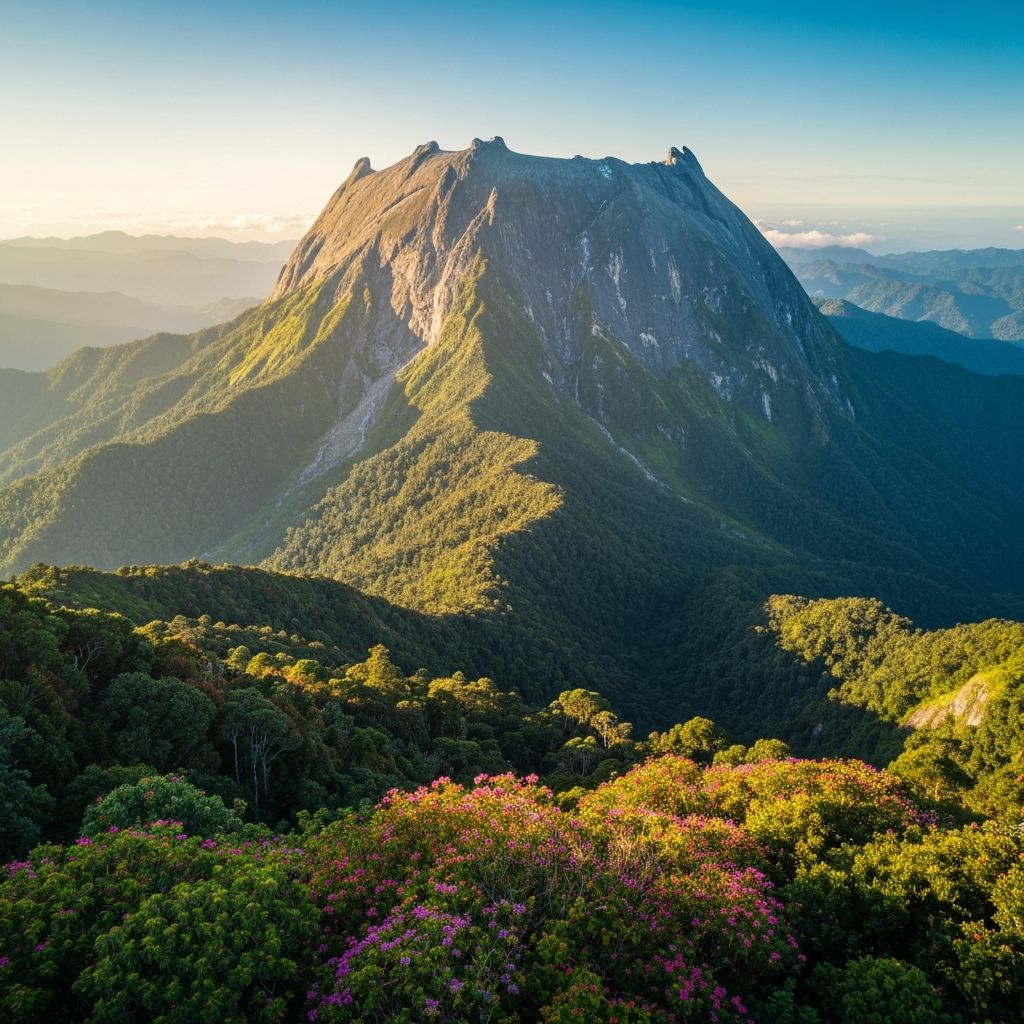
Mount Kinabalu
Southeast Asia's highest peak and a UNESCO World Heritage Site offering unforgettable climbing experiences
Location
Kinabalu National Park, Sabah, Borneo
Summit Height
4,095 meters (Low's Peak)
Climbing Duration
2 days, 1 night (typical route)
Southeast Asia's Towering Giant
Standing majestically at 4,095 meters above sea level, Mount Kinabalu reigns as Southeast Asia's tallest peak and serves as the crowning jewel of Malaysian Borneo. This magnificent granite massif dominates Sabah's landscape, its summit piercing through tropical clouds to touch the equatorial sky. Recognized as a UNESCO World Heritage Site since 2000, this mountain sanctuary protects extraordinary plant diversity with over 6,000 species thriving across multiple climate zones from lowland tropical forest to alpine scrubland. The Kadazan-Dusun indigenous communities revere this mountain as sacred, believing departed spirits find eternal rest among its peaks. For adventure travelers worldwide, conquering Mount Kinabalu represents a bucket-list achievement that combines physical challenge with spiritual connection to one of Earth's most biodiverse mountains. The climb rewards those who accept its challenge with sunrise vistas that rank among nature's most spectacular displays, where dawn paints the sky while clouds drift through valleys thousands of feet below.
The Summit Quest
Most climbers tackle Mount Kinabalu via the Timpohon Route, which departs from park headquarters at 1,866 meters elevation. This well-maintained trail stretches 8.7 kilometers upward through dramatically changing ecosystems, terminating at Laban Rata's mountain lodges perched at 3,272 meters. Day one typically requires 5-7 hours of steady climbing, beginning through dense montane rainforest where towering trees create a cathedral-like canopy draped in moss and epiphytes. As altitude increases, the forest character transforms—first to cloud forest with gnarled trees emerging from perpetual mist, then to dwarf vegetation and eventually exposed rocky slopes with hardy alpine plants. Overnight rest at Laban Rata provides crucial acclimatization while hot meals and comfortable beds prepare climbers for the pre-dawn summit assault. Around 2:00 AM, headlamps pierce the darkness as determined climbers begin the final 2.7-kilometer push to Low's Peak, navigating increasingly steep granite slopes with fixed ropes assisting on challenging sections. No technical mountaineering skills are required, but stamina, determination, and proper pacing prove essential. Reaching the summit as dawn breaks creates indelible memories—standing atop Southeast Asia while the rising sun illuminates surrounding peaks and valleys filled with clouds takes one's breath away in ways beyond the thin air.
Mountain Biodiversity
Beyond challenging climbs, Kinabalu National Park offers exceptional opportunities for non-climbers and nature enthusiasts. The park headquarters zone features multiple well-marked trails varying from leisurely 30-minute strolls to demanding half-day treks through primary rainforest. The Mountain Garden showcases highland flora native to Kinabalu's slopes, including spectacular orchid varieties, vibrant rhododendrons, and fascinating carnivorous pitcher plants that trap insects in specialized leaves. The Silau-Silau and Liwagu trails wind through pristine forest where birdwatchers can spot endemic species like the Kinabalu friendly warbler and mountain blackeye. This botanical wonderland contains more plant diversity than all of Europe and North America combined—over 1,000 orchid species alone grow here, many found nowhere else on Earth. Educational displays at park headquarters explain the mountain's geological origins as a massive granite pluton pushed upward millions of years ago, creating ideal conditions for species evolution. For additional adventure, nearby Poring Hot Springs offers natural thermal pools for post-hike relaxation and a spectacular 158-meter-long canopy walkway suspended 41 meters above the forest floor, providing treetop perspectives and potential wildlife encounters.
Via Ferrata Thrills
Adventure seekers can enhance their Kinabalu experience with the world's highest via ferrata—a system of steel cables, rungs, and suspension bridges bolted directly onto the mountain's granite face. This exhilarating descent route transforms the return journey into an adrenaline-pumping adventure traversing vertical cliff faces hundreds of meters above forested valleys. Two routes cater to different experience levels: Walk the Torq (2-3 hours) suits first-timers with moderate exposure and thrilling moments, while Low's Peak Circuit (4-5 hours) challenges experienced participants with a spectacular 400-meter traverse across sheer rock walls. Both routes begin after summiting, adding extraordinary dimensions to the climbing achievement. Participants remain securely harnessed and clipped to fixed cables throughout, with professional guides ensuring safety and providing encouragement. The experience delivers heart-pounding moments stepping onto narrow ledges with nothing below but clouds and mountain scenery, creating unforgettable memories and spectacular photo opportunities. The via ferrata successfully combines mountaineering adventure with technical challenge, offering perspectives of Kinabalu's dramatic geology impossible to experience any other way.
Indigenous Heritage
To Sabah's indigenous Kadazan-Dusun people, Mount Kinabalu embodies spiritual significance as "Aki Nabalu"—the revered resting place of departed ancestors. Ancient beliefs hold that spirits dwell among the peaks, demanding respectful behavior from those who venture onto sacred slopes. Traditional protocols required offerings before ascending, and many guides continue these customs, performing brief ceremonies at trailheads acknowledging the mountain's spiritual importance. Multiple theories explain the name Kinabalu itself—some scholars link it to "Aki Nabalu" while others suggest derivation from Kadazan words "Kina" (Chinese) and "Balu" (widow), connected to romantic legends about a Chinese prince and local maiden. Historically, Kadazan-Dusun communities undertook pilgrimages to honor ancestors, viewing the mountain as holy ground connecting earthly and spiritual realms. This deep cultural heritage enriches the modern climbing experience, reminding visitors that Mount Kinabalu transcends mere physical challenge—it represents a sacred peak that has shaped indigenous culture and spiritual practices for countless generations, deserving reverence alongside adventure.
Unique Wildlife
Mount Kinabalu's dramatic elevation range creates multiple distinct habitats supporting remarkable wildlife diversity. Lowland forests harbor majestic dipterocarp trees while mid-elevation zones feature dense oak and rhododendron forests sheltering numerous endemic bird species. Over 300 bird varieties inhabit these forests, including the stunning Whitehead's trogon and Kinabalu-endemic mountain blackeye found nowhere else globally. Mammals range from lowland species like wild boars and barking deer to montane specialists including the rare Bornean ferret badger and peculiar Kinabalu giant red leech. Orchid enthusiasts travel globally specifically for Kinabalu's legendary diversity—over 1,000 species include rare endemic varieties found only on these slopes. Carnivorous pitcher plants (Nepenthes) thrive in nutrient-poor soils, with several species unique to Mount Kinabalu including the spectacular N. rajah, large enough to trap small vertebrates. Above 3,000 meters, vegetation transforms into unique alpine communities dominated by hardy shrubs and the twisted Leptospermum recurvum, adapted to harsh conditions including frequent temperature extremes and intense UV radiation. This concentration of endemic species makes Kinabalu one of the world's most important biodiversity hotspots, attracting botanists and nature enthusiasts from every continent.
Climbing Essentials
Successfully climbing Mount Kinabalu requires advance preparation as Sabah Parks limits daily permits to protect fragile ecosystems. Bookings must go through licensed tour operators or directly via Sabah Parks, with packages including climbing permits, mandatory mountain guides, Laban Rata accommodation, and meals. Physical preparation significantly enhances enjoyment—regular cardiovascular exercise and practice hikes with elevation gain prepare muscles and cardiovascular system for sustained climbing. While Kinabalu can be attempted year-round, March through September typically delivers drier conditions and clearer summit views. Essential gear includes quality hiking boots with good ankle support, warm layered clothing (summit temperatures drop near freezing), waterproof rain gear, bright headlamp for pre-dawn climbing, refillable water bottles, and energy-rich snacks. Most climbers rent cold-weather jackets and pants at park headquarters, avoiding the need to pack bulky items. Altitude sickness affects some climbers despite moderate elevation, making slow ascent pace and constant hydration crucial for success. The descent completes on day two after sunrise summit experience, requiring 3-4 hours back to park gates. Total costs range from RM 1,500-2,500 depending on package inclusions and group size. Standing atop Southeast Asia's highest point, watching dawn paint the sky while clouds swirl thousands of feet below, creates lifetime memories that make every challenging step worthwhile—Mount Kinabalu beckons adventurers to accept its challenge and experience Borneo's mountain majesty firsthand.